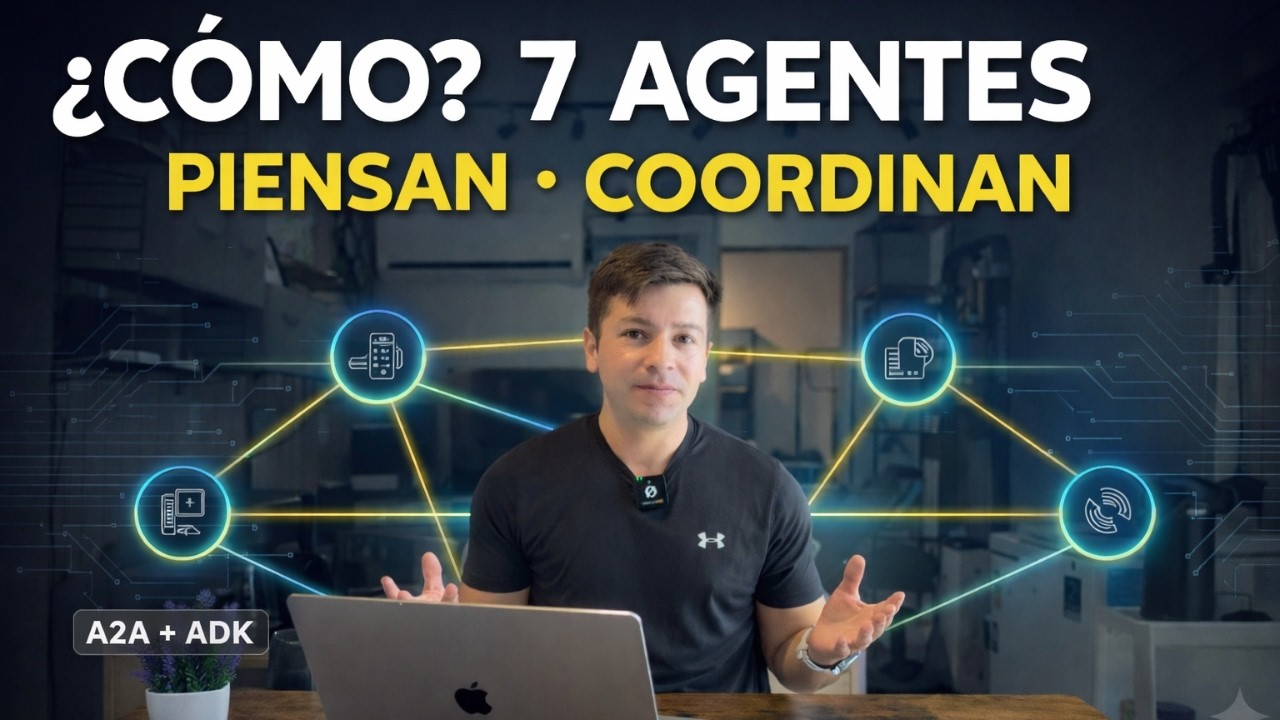
Google ADK: 7 AI agents build an Internal Developer Platform live
VIDEO · 49 min

Google ADK · A2A Protocol · SequentialAgent

7 AI agents that
build your IDP
on their own

No human intervention. Zero clicks. Pure multi-agent orchestration. Docker Compose, Jenkins, Grafana, CLI and FastAPI portal generated by specialized agents with Gemini function calling.

The analogy that explains everything

Imagine a real development team.

Tech Lead defines the architecture and writes a design document
Backend Dev doesn't wait for anyone to hand them anything — reads the document and starts coding
Frontend Dev reads the API documentation that Backend generated — no intermediary
DevOps reads both specs and sets up the corresponding infrastructure

Nobody passes them variables. Nobody coordinates them manually. Each one finds and reads what the previous left written. That's A2A in the real world: asynchronous communication through shared artifacts.

That's exactly what these 7 agents do. No human intervention, zero clicks, zero editing, pure multi-agent orchestration.

What the system generates

Result first, explanation second. This is what you find in the output directory when the 7 agents finish.

Generated output — 21 files

test-outputs/idp-adk-sequential/

├── platform-config.yaml ← Architect

├── docker-compose/

│ └── app-stack.yml ← Infrastructure

├── security-report.json ← Security

├── cicd/ ← CI/CD

│ ├── build.sh

│ ├── test.sh

│ └── deploy.sh

├── Jenkinsfile ← CI/CD

├── grafana-dashboards/ ← Observability

│ ├── app-metrics.json

│ └── system-metrics.json

├── cli-tool/idp ← DevEx

├── portal/ ← Web Portal

│ ├── main.py

│ ├── templates/index.html

│ └── Dockerfile

└── orchestration-report.json ← Orchestrator

🏗️

Docker Compose

Services with healthchecks, networks and volumes

🔒

Security Report

Vulnerabilities detected by the security agent

⚙️

CI/CD Scripts

build.sh, test.sh, deploy.sh + configured Jenkinsfile

📊

Grafana Dashboards

App metrics + System metrics, ready to import

💻

CLI Tool

Executable with commands adapted to the generated stack

🌐

FastAPI Portal

Web dashboard with real-time Docker visualization

📋

Platform Config

Stack decision documented with AI justification

The 7 specialized agents

Each agent has a single responsibility and actively reads what the previous ones left behind. None receive direct parameters — all search for the shared artifacts.

1

Platform Architect

platform-config.yaml ~40s

Analyzes the task and decides the full stack: runtime, framework, database, CI/CD, monitoring. Justifies each decision. Saves the configuration to a YAML file.

2

Infrastructure

docker-compose/app-stack.yml ~32s

Reads the Architect's YAML and generates the complete Docker Compose with all services, healthchecks, networks and volumes.

3

Security

security-report.json ~8s

Reads the Architect's decisions and the generated infrastructure. Scans with Trivy: exposed secrets, open ports, images with CVEs. Can block the pipeline if it detects critical issues. Generates a structured report.

4

CI/CD

cicd/ + Jenkinsfile ~56s

Reads the decided stack and generates adapted automation scripts: build, test and deploy. Configures the Jenkinsfile for the complete pipeline.

5

Observability

grafana-dashboards/ (2 JSONs) ~28s

Reads the infrastructure configuration and generates two Grafana dashboards: application metrics and system metrics. Configures Prometheus.

6

DevEx

cli-tool/idp ~40s

Reads the complete stack and generates an executable CLI tool with commands adapted to the project: status, logs, deploy, rollback, scale and more.

7

Web Portal

portal/ (FastAPI + HTML) ~66s

Reads the complete IDP configuration and builds a web portal with FastAPI backend, HTML templates and real-time visualization of Docker services.

Total: ~4.5 minutes · 21 files · 7/7 agents

How it works: SequentialAgent + A2A Protocol

SequentialAgent executes the 7 agents in order. But what makes the system truly work is A2A: each agent writes its decisions to a file and the next one actively reads them.

Communication flow

# Architect writes

save_platform_config("Runtime: Python...")

→ platform-config.yaml saved

# Infrastructure searches and reads

get_platform_config()

→ reads the architect's YAML

→ generates Docker Compose

# Security also searches

get_infrastructure_config()

→ reads infrastructure decisions

→ identifies vulnerabilities

Without A2A — classic pipeline

Agent 1 → return output → Agent 2

Direct coupling. If one fails,

the whole chain breaks.

With A2A — shared artifacts

Agent 1 → writes YAML

Agent 2 → actively reads YAML

Each agent is independent.

Localized debugging. Modular.

SequentialAgent — the orchestrator

Built-in in Google ADK. Pass it the list of agents and it executes them in order. The orchestrator doesn't use an LLM — the sequence is deterministic.

from google.adk.agents import SequentialAgent

orchestrator = SequentialAgent(

name="idp_orchestrator",

sub_agents=[

platform_architect, # 1. Defines stack

infrastructure, # 2. Reads and generates Docker Compose

security, # 3. Reads and scans

cicd, # 4. Reads and generates scripts

observability, # 5. Reads and generates dashboards

devex, # 6. Reads and generates CLI

web_portal # 7. Reads everything and generates portal

]

)

Tools in ADK: simple Python functions

Each agent has tools defined as standard Python functions. No mandatory decorators, no manual JSON schemas. ADK registers them and Gemini decides when and how to call each one.

How a tool is defined in ADK

# Regular Python function

def save_platform_config(

stack_summary: str

) -> dict:

"""

Args:

stack_summary: "Runtime: Python 3.11

| Framework: FastAPI | ..."

"""

# parses and saves config

return {"status": "success"}

# Gemini decides when to call it

# You just define it and register it

The problem we solved

With 13+ parameters per function, Gemini failed at function calling. The success rate was 0%.

❌ 13 parameters → 0% success rate

save_config(runtime, framework, database, cloud, cicd, cache, monitoring...)

The solution

Reduce to 1 parameter with structured format in the string. The success rate became very high.

✓ 1 parameter → high reliability

save_config("Runtime: Python | Framework: FastAPI | ...")

The pattern we replicated across all 7 agents

This same pattern — 1 parameter with pipe-separated format — was applied to the tools of all agents. The result: 7/7 agents with high function calling success rate. It's a real technical finding, discovered during development.

1 tool, 1 responsibility, minimal inputs — it's exactly the Agent Skills principle applied to ADK.

Real AI, not hardcoded templates

The Platform Architect makes real decisions on each run. The same task can produce completely different stacks — because the model reasons, it doesn't fill a template.

Run 1

"Build IDP for Python microservices"

Python 3.11
FastAPI
PostgreSQL
Redis
Jenkins
Trivy

Run 2

"Build IDP for Python microservices"

Python 3.11
FastAPI
SQLite
Jenkins
Prometheus
Bandit

Run 3

"Build IDP for Go microservices"

Go 1.21
Gin
PostgreSQL
GitHub Actions
Grafana
Trivy

It also adapts in real time during the conversation

In the interactive mode shown in the video, the Platform Architect receives new instructions during the conversation and adapts its recommendations in real time: starts by recommending a local stack with Trivy, then switches to Google Cloud when asked, and finally adjusts to AWS + GitLab when that combination is specified. With each change, it explains why the previous recommendation no longer applies.

The moments you won't forget

There are three scenes in the video that show real multi-agent orchestration — not simulated.

1

The empty folder that fills itself

Before launching automatic mode, the screen shows that the test-outputs/ directory is completely empty. On pressing enter, each agent starts working in sequence — and files appear in real time in the file explorer. When done: Docker Compose, Jenkinsfile, Grafana dashboards, FastAPI portal, CLI tool. All there.

2

The security agent that can't proceed

In interactive mode, the security agent receives a request. Before doing anything, it actively reads the architect's decisions and the infrastructure agent's decisions. Since infrastructure hasn't run yet, it responds:

Security Agent:

"I have tried to read the infrastructure agent's decisions,

but they were not found. The infrastructure agent

must run first."

# It wasn't hardcoded. The agent truly knows

# what state the system is in.

3

Jenkins, Grafana and the portal appear for real

After the agents finish, docker-compose up -d runs with the AI-generated file. Jenkins starts with the CI/CD job already configured. Grafana loads with the generated dashboards. The FastAPI portal responds at localhost:8001 showing the status of all services in real time. None of this is a simulation.

Two modes, one architecture

The same 7 agents, two ways to interact with them.

Interactive

Web interface at localhost:8000

Chat with each agent separately from the browser. Ideal for exploring what each one does, changing preferences and seeing decisions in real time.

# One command launches everything

./start-interactive-nicolasneira.sh

# Opens localhost:8000

# Select the agent

# Chat in natural language

  • Iterative conversation with each agent
  • Change the stack during the session
  • See each decision as it's made
Automatic

End-to-end pipeline with no intervention

One command, 7 agents run in sequence, 21 files generated. Watch progress in the terminal in real time.

# One command, ~4.5 minutes

./start-demo-nicolasneira.sh \

"Build IDP for Python microservices"

# ✓ 21 files generated

# ✓ Portal at localhost:8001

  • Complete pipeline with no human intervention
  • Different output on each run
  • Customizable by prompt

Quick Start

1. git clone https://github.com/nneira/google-adk-a2a-idp

2. export GEMINI_API_KEY="your-api-key"

3. docker build -t adk-agents:hybrid .

4. ./start-demo-nicolasneira.sh "Build IDP for Python microservices"

Gemini API key available at aistudio.google.com/app/apikey

Frequently asked questions

The most common questions about Google ADK, Gemini function calling and the multi-agent system.

What is Google ADK?

+

Google ADK (Agent Development Kit) is Google's official framework for building AI agents with Gemini models. It lets you define agents as Python objects with tools, instructions and an assigned model, and orchestrate them in multi-agent systems using components like SequentialAgent. Unlike other frameworks, ADK is designed specifically for Gemini and offers function calling with no additional schema configuration. In this project it's used to coordinate 7 specialized agents that autonomously generate a complete Internal Developer Platform.

What is Gemini function calling?

+

Gemini function calling is the ability of the Gemini model to decide when and how to invoke Python functions that you define. Instead of your code calling the AI and waiting for text, the model analyzes the context and executes concrete functions: save a file, query an API, read a configuration. In Google ADK you define those functions as standard Python with type hints and docstrings — the framework registers them and Gemini decides when to call them. The key technical insight from this project: more than 13 parameters per function drops the success rate to 0%. The solution is consolidating to 1 parameter with a structured format.

What is A2A Protocol?

+

A2A (Agent-to-Agent) Protocol is a communication standard between AI agents, part of the Linux Foundation, that allows them to coordinate without a central orchestrator passing data directly between them. Instead of direct calls between agents, each one writes its decisions to shared artifacts — YAML files, JSON, configurations — and the next agent actively searches for and reads them when needed. In this project the Infrastructure agent doesn't receive data from the Architect as a parameter: it searches for it in the file system. This makes each agent independent and keeps debugging localized.

What is SequentialAgent in Google ADK?

+

SequentialAgent is a built-in orchestrator agent type in Google ADK that executes a list of sub-agents in deterministic order, one after another. It doesn't use an LLM to decide the sequence — execution is fixed and predictable. You define it by passing a list of agents and ADK handles executing them in that order. In this project it coordinates the 7 specialized agents: Platform Architect first, then Infrastructure, Security, CI/CD, Observability, DevEx and Web Portal — approximately 4.5 minutes total.

Why gemini-2.5-flash and not flash-lite?

+

Flash-Lite has inconsistent tool calling with this system — agents keep chatting instead of executing functions. Gemini 2.5 Flash has a very high success rate for this type of orchestration. The cost difference is minimal; the reliability difference is enormous.

Can I use GPT-4 or Claude instead of Gemini?

+

Yes, Google ADK supports other models via LiteLLM — including Claude and GPT-4. A2A Protocol is model-agnostic by design: it's an open Linux Foundation standard, not tied to any provider. The repository as-is uses Gemini 2.5 Flash with the google-genai SDK, but you can adapt the model by changing the agent configuration to LiteLLM without rewriting the tools or orchestration logic.

Are the generated files production-ready?

+

They're an excellent starting point — 80% of the work is done. Before going to production you should review: hardcoded passwords, secrets management and the recommendations in the security-report.json that the system generates for you.

Can I add more agents or change the stack?

+

Yes. The SequentialAgent accepts N agents — to add one, define its Python function and add it to the sequence. To change the stack, adjust the prompt to the Platform Architect: it makes the decision based on what you ask.

What happens if an agent fails?

+

The system has automatic retries: up to 3 attempts with exponential backoff before declaring a failure. If the failure is critical, the orchestrator does a rollback in reverse order and cleans up the generated files. In practice: you can restart from the agent that failed without losing the work of the previous ones.

Resources

Full repository

github.com/nneira/google-adk-a2a-idp

Full video — 49 min

youtube.com/@NicolasNeiraGarcia

AS

Why are this IDP's agents well designed? → Agent Skills

Each agent in this system follows the Agent Skills pattern: scoped, reusable and safe. If you want to understand the conceptual architecture behind how the tools were designed, the separation of layers and why A2A works this way — that's the page.